Success Probabilities
Some math for everyone out there trying to prove something to themselves and the world.
Making art, writing a novel, launching a product that gets traction, 0 -> 1 endeavors, these things are hard but rewarding.
Next morning I went over to Paul's for coffee and told him I had finished. "Good for you," he said without looking up. "Start the next one today."
Steven Pressfield, The War of Art
So what do we do, swinging and hoping for the best? Sort of, but it helps to have a strategy as we swing:
God, grant me the serenity to accept the things I cannot change, the courage to change the things I can, and the wisdom to know the difference.
Reinhold Niebuhr
OK, so we should come up with a plan and then keep trying. We can keep trying, but it helps to know how much we should expect to have to try. And to answer this, let's simplify and use probability theory:
- Each time you try you make it with probability p
- and miss with probability 1 - p.
Let's say any one novel has a 10% chance of working. p = 0.10, so a miss is 0.90.
If the attempts don't affect each other, the probabilities multiply. The chance all N of them miss is (1 - p)^{N}. The chance at least one works is everything else:
Practically speaking, though, you get better as you try more.
What do you do if you try and you miss? You try again.
| tries | ≥1 works | all miss | expected wins | |
|---|---|---|---|---|
| 1 | 10% | 90% | 0.1 | |
| 2 | 19% | 81% | 0.2 | |
| 3 | 27.1% | 72.9% | 0.3 | |
| 5 | 41.0% | 59.0% | 0.5 | |
| 7 | 52.2% | 47.8% | 0.7 | |
| 10 | 65.1% | 34.9% | 1.0 | |
| 15 | 79.4% | 20.6% | 1.5 | |
| 22 | 90.2% | 9.8% | 2.2 | |
| 30 | 95.8% | 4.2% | 3.0 | |
| 44 | 99.0% | 1.0% | 4.4 |
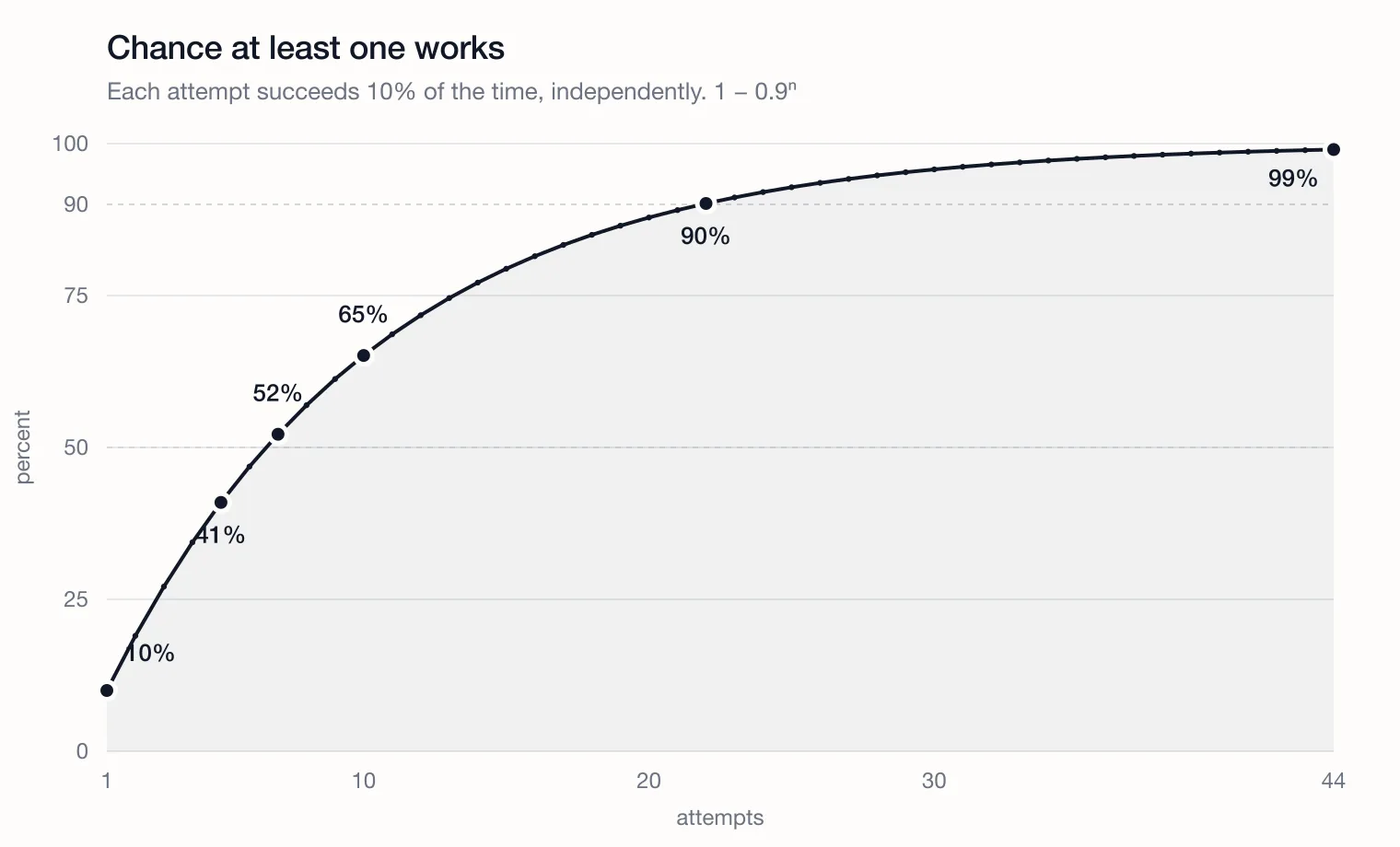
You can also increase values of p, but that's outside the scope of this post.
Now go swing.