Agents as system /devices
What if we could interact with our agents using /dev?
What if we could interact with our agents like we do standard linux device drivers?
Today we use somewhat opaque APIs and inspecting agent-traffic takes some time, effort, and SSL interception (which is generally a good thing). It makes sense that we are where we are right now - it wouldn't have made sense for the first chat CLIs to be their own /devices or /procs when they first came out a few years ago.
But now that they've definitely found product market fit, I think this could make a lot more sense. This is here to stay, and some of the coolest new things happen when we can experiment and tinker freely.
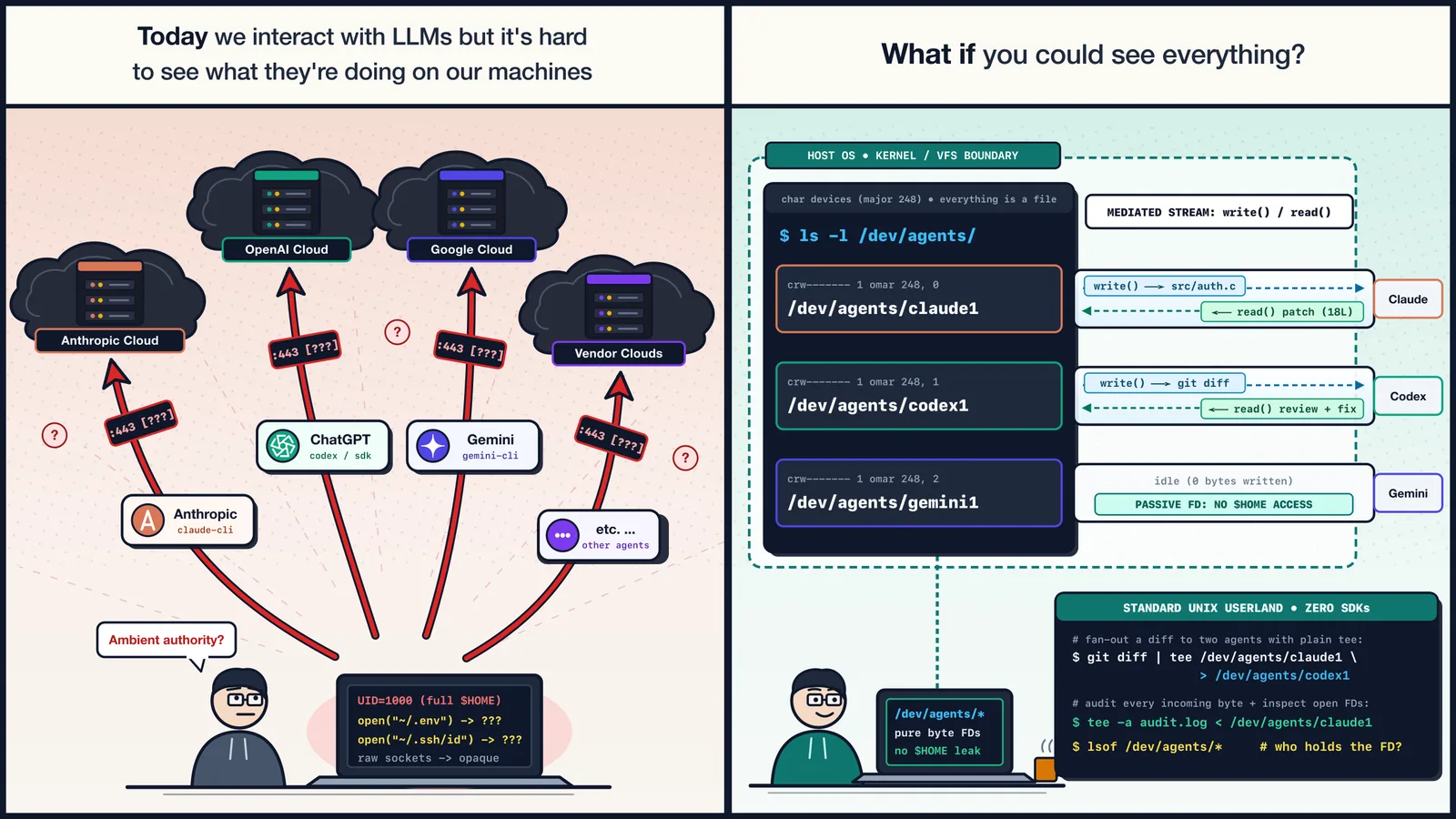
Some things we could do:
what is the agent thinking?
tee -a thinking.log < /dev/agents/claude1/thinking
streaming chain of thought, live, into a second watchdog/critic while watching it on stdout
tee /dev/agents/codex1/io < /dev/agents/claude1/thinking
But even bigger: agents could introspect and see what other agents are thinking/doing.
We could also use standard linux filesystem permissions to decide who can see what.
I built devtee.com with the goal of logging what MMA (me and my agents) are doing/thinking.
Also, as we move away from the prompt-response model for interacting with agents (to things like continuous conversation, see what Thinking Machines are doing), a /dev approach could be beneficial, since agents could get a continual read on what we're doing.
This could go in a lot of interesting directions -- for example, let's say we wanted to prompt an LLM and we wanted it to see our reaction as it responded - we could pipe /dev/webcam | process-emotion-from-stream > /dev/agent/input/emotion0.
Treating agent streams as linux device drivers would:
- give the end user more control and visibility into what their agents are doing, without necessarily sacrificing the user experience.
- create a lot of interesting opportunities for making new things, and finding better ways for us to interact with our agents.
How could we try this?
Proof-of-possible solution:
MITM-proxy, intercept SSL, and then re-run the network request. Should be possible as I assume traffic is encrypted with system SSL certs, so anything is possible given you have keychain access to your own system.
Scoping v0
The goal of v0 is to get the core Unix workflows (tee, tail -f, cat, echo, chmod) working against real agents we already use today—without writing a kernel module or requiring a custom SDK.
1. Userspace filesystem, not a kernel driver
Writing a real character device driver (.ko on Linux, DriverKit/kext on macOS) is unnecessary friction for v0:
- Linux: an unprivileged
libfuse3daemon (devagentsd) mounted at/dev/agents(or/run/user/$UID/agentssymlinked in). - macOS:
/devis managed bydevfsandmacFUSErequires a kernel extension, sodevagentsdcan expose a local loopback NFSv3 server (the same zero-kext trick Lima and OrbStack use) mounted at~/dev/agentsor/Volumes/agents.
Every file is plain UTF-8 text so standard tools (grep, sed, awk, jq, tee) work without bespoke parsers.
2. Ground-truth capture via local MITM proxy
Wrapper commands (ANTHROPIC_BASE_URL=...) only see processes you remember to wrap—they miss desktop IDEs, background subagents, Electron apps, and silent side-channel calls (title generation, telemetry, repo indexing).
- Intercept
localhost <> LLM APItraffic directly (mitmproxy+ local CA): trusting a local root CA in your system keychain (andNODE_EXTRA_CA_CERTS/SSL_CERT_FILEfor runtimes with bundled CAs) letsdevagentsdtransparently inspect every HTTPS connection toapi.anthropic.com,api.openai.com,generativelanguage.googleapis.com, etc. Any agent running anywhere on your machine automatically materializes in~/dev/agents/the moment it opens a request—anddevagentsddemultiplexes its SSE chunks (reasoning tokens, tool calls, text) into live files in real time. - Spawn a bare stream agent:
mkdir ~/dev/agents/claude1creates a headless session backed directly bydevagentsd, ready to take prompts overio.
3. Minimal directory layout
One directory per live agent, six files:
agents/
  claude1/
    ctl        # write-only: pause, resume, cancel, model <id>
    io         # read/write: write a prompt, read streamed assistant text
    thinking   # read-only FIFO/stream: live chain-of-thought tokens
    trace      # read-only append log: tool calls, file opens, outbound requests
    context    # read-only snapshot of the current context window (JSONL or chat.xml)
    status     # read-only one-liner: idle | streaming | tool_call | paused
Read semantics matter:
thinkingandiobehave like character streams (blockingread()until end-of-turn EOF, or continuous withtail -f), sotee ~/dev/agents/codex1/io < ~/dev/agents/claude1/thinkingworks naturally.contextandstatusbehave like/proc/<pid>/status: opening and reading them synthesizes a point-in-time snapshot (wc -c,diff,chat.xml).ctlaccepts newline-terminated commands (echo "pause" > ~/dev/agents/claude1/ctlholds the next outbound API turn at the proxy untilresumeorcancel).
4. Permissions & multi-agent introspection
Standard POSIX mode bits on each file (chmod, chown, groups) map directly to enforced access rules in devagentsd:
chmod 640 claude1/thinkinglets a critic/watchdog agent in the same group readclaude1's reasoning stream, whilechmod 600 claude1/ctlensures only your user (or a designated supervisor UID) can pause or steer it.- Cross-agent loops are just shell pipelines—no orchestration framework required:
# critic watches worker's thinking and pauses it if it loops
tee >(grep -q "wait, actually" && echo "pause" > ~/dev/agents/claude1/ctl) \
  < ~/dev/agents/claude1/thinking
5. Explicit non-goals for v0
- No kernel modules or root daemons (except optional mount helpers).
- No binary
ioctlframing—plain text commands onctl(Plan 9 style) beat C structs. - Defer full filesystem sandboxing (
mounts) tov0.1—start by tracing network and tool activity across intercepted sessions (trace) and pausing onctl, then layer Linux mount namespaces (bwrap/unshare) and macOSsandbox-execon top once the stream primitives feel right.
some v0 open questions
- how do we want to name the streams?
- guessing APIs use UUIDs for conversations?
/dev/agents/claude/<uuid>,/dev/agents/claude-<uuid>, something else? Thinking about how filesystems are mounted by uuid.
- How could we intercept and redirect network traffic?
- comparing
~/.agentand what we're seeing in wiredumps
Also, we could build atop. This would also make it much easier to measure how much time your agents are spending waiting on you.